
A new technology based on the analysis of muons, emitted from cosmic radiation, makes it possible to scan containers and trucks, much better than X-rays.

PAR ERWAN SEZNEC
Deputy Editor-in-Chief of the Society section
Published on 13/01/2026 at 09:00
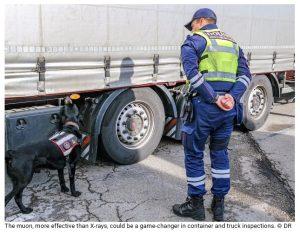
One in a hundred. That’s the proportion of containers entering France that are currently inspected. It’s a matter of arithmetic and human resources. The largest ships, like the CMA-CGM Bougainville, carry 18,000 “twenty-foot equivalent units,” or TEUs. At 10 minutes per container, it would take 125 days to inspect the cargo. The same applies to the large cross-Channel ferries.
They can carry a thousand passengers, a hundred cars, and just as many buses and trucks. Even a cursory inspection takes a minimum of three minutes. Checking 100% of the vehicles would take 10 hours. Drug traffickers and migrant smugglers know this.
In Calais, their tactic is to send convoys of trucks carrying stowaways to the United Kingdom [lepoint.fr]. Those unlucky enough to get caught are reimbursed in full. The overall success rate allows for this.
Pragmatic Traffickers
Another example of the intensity of trafficking: on May 24, 2022, customs officials announced 24 hours in advance that they would be checking 100% of the luggage on a Cayenne-Paris flight, a well-known route for importing South American cocaine into Europe. Of the 283 passengers, 50 failed to check in! Here too, traffickers are engaging in pragmatic calculations. Random checks will lead to seizures, but they will always be too infrequent to eliminate the trade. An increase in checks would change the situation, but this requires resources: customs resources, police resources, dogs, and X-rays.
X-rays are very useful. There are portals large enough to scan an entire container or truck. But they have, unfortunately, limitations well known to traffickers. They are ineffective through water or through metal walls of a certain thickness.
READ ALSO
Cocaine, the new king of the French drug market [lepoint.fr]
Furthermore, because X-rays are hazardous to health, operators are subject to complex safety procedures. During the scan, the truck driver or bus passengers must move away. Continuous monitoring of the flow of traffic is impossible.
Small but mighty, the muon
Bad news for criminals: a newcomer could change the game. It’s called the muon, and it falls from the sky. Muons are created by the interaction of cosmic rays with the upper atmosphere, rays that constantly bombard the Earth. These particles have a very short lifespan (two microseconds), but since they travel at the speed of light, they have plenty of time to reach the ground.
With a mass 200 times greater than that of electrons, muons are energetic enough to overcome any obstacle. In doing so, they are partially absorbed or deflected. By analyzing the absorption rates and trajectories of muons, we can therefore infer the nature of the materials they pass through. Eureka!
In practical terms, it took a lot of effort to develop an operational system. It now exists. It is marketed by an American company called Decision Sciences International Corporation.
It all began after the attacks of September 11, 2001. Deeply concerned by the possibility of a chemical or nuclear “dirty bomb” arriving in a shipping container, the American government finally passed a law and asked Los Alamos National Laboratory (founded by Robert Oppenheimer [lepoint.fr] in 1943) to develop an innovative detection device.
Physicist Chris Morris then conceived a tomography, or 3D imaging, technique based on muons arriving at the Earth’s surface. These muons pass through a first detector, then the object to be studied, and finally a second detector paired with the first.
READ ALSO
Cocaine versus cannabis: a flourishing trade [lepoint.fr]
The system makes it possible to track the trajectory of muons as they interact with the atoms of the object, no matter how colossal and massive it may be. As early as the 1960s, the American physicist Luis Walter Alvarez, Nobel Prize winner in 1968, used muons to find hidden chambers in the pyramids of Egypt!
From Nobel Prize in Physics to Engineering
Transforming a Nobel Prize-worthy achievement into a tool usable by customs officers was no easy task. The Los Alamos National Laboratory, a public fundamental research center, licensed the muon tomography technology in 2006 to Decision Sciences, a private company it helped create. “We started with the nuclear threat,” says its CEO, Stuart Rabin. Toshiba was one of the first customers to invest in using Decision Sciences’ technologies to scan the core of the melted reactor at the Fukushima power plant after the 2011 tsunami. Then, explains Stuart Rabin, “we embarked on building a system to deploy in a port to demonstrate that it was possible to scan trucks and cargo containers using muon tomography, without radiation and quickly enough.”
READ ALSO
On the docks of Le Havre, the slow poison of cocaine trafficking [lepoint.fr]
And it works! The product is called Discovery, a registered trademark covered by numerous patents. The port of Singapore was the first in the world to be equipped with Discovery muon tomography scanners. The United Arab Emirates followed suit, investing in Port Khalifa, Abu Dhabi. Two other systems were purchased by the U.S. Department of Defense, and a fifth is in operation at Nogales, an Arizona border crossing through which many illicit shipments and undocumented immigrants from Mexico pass.
Today, Decision Sciences is “in advanced discussions with more than a dozen different clients,” explains Stuart Rabin. In Europe, the Dutch could be the first to adopt the technology, to strengthen surveillance at the port of Rotterdam. Dutch customs has already sent a delegation to San Diego, California, to observe the Discovery detection portals in operation.
France is very interested.
In France, customs officials are refusing to comment, but contacts with Decision Sciences are no longer a secret. The plan is to initially equip Calais and Marseille, respectively for migrants and for drugs and other illicit substances.
But what are European manufacturers and researchers doing? They are working, but they have fallen behind. The European Union launched its muon tomography detection program, called SilentBorder, in 2021. It brings together universities and companies from several member states (Germany, Belgium, Finland, Spain, Estonia, Italy, as well as Switzerland and the UK). A small demonstrator was presented to the public in Estonia in June 2025.
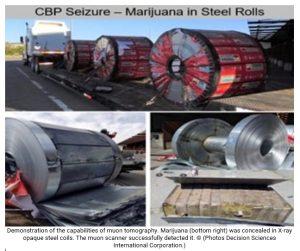
Decision Sciences’ technology is operational at several sites around the world, accumulating feedback that feeds into artificial intelligence to refine detection. It is already impressive. In Nogales, Stuart Rabin recounts, “we discovered drugs concealed in steel coils,” which X-rays cannot penetrate. Customs officers had X-rayed the shipment three times but saw nothing but enormous black circles. “Our system, in one minute, penetrated the steel without emitting any radiation and revealed the presence of anomalies indicating contraband,” the CEO concludes.
Detecting Submarines
Since muons travel through water, the company is now working on detecting submarines used by drug traffickers. With a detector placed at the bottom of a strategic, relatively shallow strait, on the order of a few dozen meters deep, such as the English Channel near Calais-Dover, it would be possible to create a veritable XXL-sized, underwater control portal.
Last but not least, especially in times of budget constraints: how much does it cost? Each portal costs several million dollars. Muon tomography is more expensive to purchase than X-ray scanners, Decision Sciences acknowledges, but it is less expensive to maintain and more effective.
READ ALSO
Drug Trafficking: France Close to Judicial Paralysis [lepoint.fr]
The company is so convinced of its effectiveness that it is prepared to organize a form of leasing, explains its representative in France, Jean-Pierre Mangiapan. “Decision Sciences would equip French ports at its own expense and would be paid a commission on the scanned containers.” He specifies that “the Americans could create an assembly site for the gantries in France,” if the country adopts the technology.
Does France even have a choice? Drug traffickers are constantly adapting. When the northern route, via Rotterdam and Antwerp, becomes more complicated, drugs take routes further south, via Le Havre, Montoire, Saint-Nazaire, and Marseille. Most likely, muon tomography detection will gradually become widespread. It may not allow for the thorough inspection of absolutely all goods entering France, but it undoubtedly has the potential to make certain illicit trafficking activities extremely risky.
ON THE SAME SUBJECT
Niort, its cocaine, its mules and its “losers” [lepoint.fr]
Drug trafficking: all hands on deck in the ports [lepoint.fr]Rennes, a model city in crisis, put to the test by crime [lepoint.fr]
